|
 3-Way High Efficiency Speaker
(Lavoce, Dynaudio, Foster 3-way. October-2023)
LCR MTM 3-Channel Speaker
(Three MTM Speakers in One. July-2023)
Mini7bt - A Minimus 7 Portable Bluetooth Speaker
(Minimus 7 and Dayton Audio. Spring-2022)
2-Way Ribbon Tweeter Speakers
(Vifa and Pioneer. May-2020)
Transmission Line Speakers
(Aborted attempt at a TL. September-2012)
Acoustic Research AR-4x Rehab
(Rehab of a garage sale find. January-2016)
Infinity RS-4000 Rehab
(Rehab of a garage sale find. June-2015)
Polaris
(A tall, thin, upwards firing omnidirectional speaker. May-2010)
Shiva_PR15
(A powered subwoofer using a 12" driver and 15" passive radiator. Jan-2010)
Can-Less
(A computer speaker; redux. December-2005)
Can-Can
(A computer speaker in a light canister. Jan-2005)
Sonosub
(10" vented subwoofer in a cardboard tube, powered by a Parapix amp. May-1999)
MTM Center Channel Speaker
(A Madisound design. Nov-1997)
2-way Surround Speakers
(5" woofer and 1" tweeter. July 1997)
3-piece mini system
(6" DVC bass module mated to 4" car speaker. June 1997)
3-way Vented Floorstanding Speaker
(vented 10" woofer, 5" mid and 1" tweeter in a 4
ft tower. Summer 1995)
NHT1259 Subwoofer
(A 12" woofer in a sealed architectural pedestal. Winter 1994-95)
Inexpensive Speaker Stands
(Particle board, sand and spray paint. Fall 1994)
2-way satellite
(6.5" woofer and 1" tweeter. Summer/Fall 1994)
| Audio Electronics Related Projects |
900 MHz Audio Receiver
(Better use for bad headphones. Jan-2008)
Buster - A Simple Guitar Amp
(Perfect for the beginner. Jan-2010)
A PC-based Audio Console
(Use a PC to play tunes. Jan-2010)
LM-12 Amp
(Bridged LM-12 opamps. Aug-2003)
CeeDeePee
(A CD player and FM tuner from spare computer parts. Oct-2002)
Quad 2000 4-Channel Amp
(Premade modules by Marantz. May-1998)
Zen Amp and Bride of Zen Preamp
(by Nelson Pass. Apr-1997)
Using Wood in Speakers FAQ
(Work in progress)
MDF FAQ for speaker builders
Woodworking Tools for the DYIer
(HomeTheaterHiFi.com Oct-1998)
Some Thoughts on Cabinet Finished for DIY Speakers
Large Grills Made Easy
Some Parts Suppliers
(Outdated)
DIY Audio Related URLs
Veneering Primer
(by Keith Lahteine)
How to get a Black Piano Finish
(by DYI Loudspeaker List members)
Sonotube FAQ
(by Gordon McGill)
Excerpts from the Bass List
(Oldies but Goodies)
DIY Loudspeaker List Archives
|


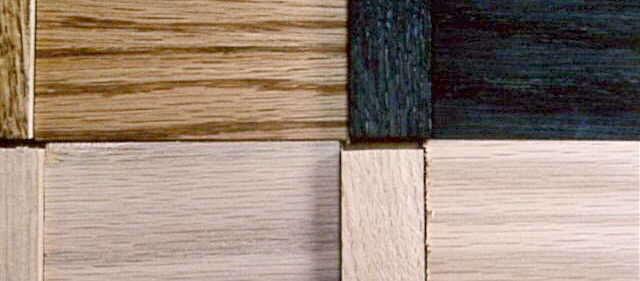 Here
is a picture of these samples. Each pair consists
of a small piece of solid oak and a larger piece of oak plywood.
The top left finish is Dark Walnut Danish Oil; the top right
is black water soluble aniline dye; the lower left is unfinished;
the lower right is white-washed with a pickling stain. (Actual
color will vary due to your monitor's gamma, brightness, contrast,
not to mention loss of image detail from jpeg compression).
I ended up using the Dark Walnut Danish Oil for an English
oak look, but strongly considered the black dye (wife liked
the pickled oak, I liked the black so we compromised on the
English oak look). Because I did not fill the pores on the
oak before applying the dye, some areas inside the pores remained
undyed. Properly filled, this finish may give a very professional
look, similar to black oak speakers found in stores.
Here
is a picture of these samples. Each pair consists
of a small piece of solid oak and a larger piece of oak plywood.
The top left finish is Dark Walnut Danish Oil; the top right
is black water soluble aniline dye; the lower left is unfinished;
the lower right is white-washed with a pickling stain. (Actual
color will vary due to your monitor's gamma, brightness, contrast,
not to mention loss of image detail from jpeg compression).
I ended up using the Dark Walnut Danish Oil for an English
oak look, but strongly considered the black dye (wife liked
the pickled oak, I liked the black so we compromised on the
English oak look). Because I did not fill the pores on the
oak before applying the dye, some areas inside the pores remained
undyed. Properly filled, this finish may give a very professional
look, similar to black oak speakers found in stores.