|
Bunk Beds in Ash
Request
for bunk bed plans are among the most frequent "request"
type posts on the rec.woodworking newsgroup. I built a set
of bunks in 1993 which have held up nicely to the abuses from
my kids. Here's what I made and the critical measurements
needed to recreate a set.
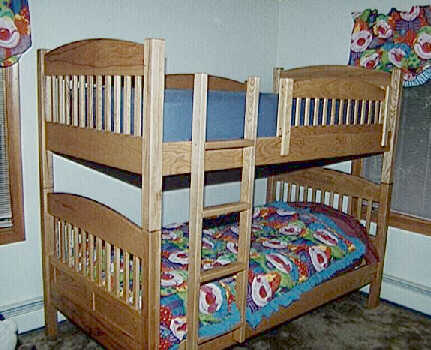 Here is a picture of my bunk beds. Refer to
it if the description below is unclear. The design is inspired
by an article in Today's Woodworker magazine (issue
18, November/December 1991, Rockler Press, 21801 Industrial
Blvd., Rogers, MN 55374-0044; available at The
Woodworkers' Store 1-800-279-4441). The wood used
is ash, mostly 6/4 stock (1.25 inch thick) which I purchased
in bulk form.
Here is a picture of my bunk beds. Refer to
it if the description below is unclear. The design is inspired
by an article in Today's Woodworker magazine (issue
18, November/December 1991, Rockler Press, 21801 Industrial
Blvd., Rogers, MN 55374-0044; available at The
Woodworkers' Store 1-800-279-4441). The wood used
is ash, mostly 6/4 stock (1.25 inch thick) which I purchased
in bulk form.
The beds
consist of six basic parts : headboard, footboard, side rails,
ladder, guard, and drawers
The finish
is Danish Oil (natural) and wax. Total cost was about $200
for the pair (I bought the ash at $1.40/bd ft) and unlike
so many commercial bunk beds, it is rock solid.
Headboard
There is
one headboard per bed. When stacked, both headboards are used
on the lower bed. The height of the headboards must therefore
be high enough for lower bunk use while retaining enough headroom
for the upper bunk.
The main
posts are 2.5 inches square, made of glued 1.25 inch stock,
and 37 inches tall. They are rounded over with a quarter inch
rounderover router bit. The posts are seperated by top, middle
and lower rails, each 39 inches long. At the top of each post
is a 1 inch diameter hole about 1 inch deep. This is used
to hold a dowel that connect the upper and lower bunk posts
when they are stacked. An ornamental piece can be made to
fit into this hole if the beds are not stacked. I made a simple
set with 2 inch wood balls and a short 1 inch dowel connector.
Each post also holds the female half of metal bed rail fasteners
(available at many woodworking stores and mail order firms),
one per post. These fasteners are mortised such that they
sit flush to the post. Take your time on this part. Additional
mortises must also be cut into these mortises to allow the
the male fastener hooks room to sit. See the actual fastener
is this doesn't make any sense ! Placement of the fasteners
is such that when assembled, the side rails will sit 9 inches
above ground.
All rails
are 1.25 inches thick. The bottom rail is 6.25 inches high.
It is fastened to the post with a 3 inch tall tenon, 1 inch
deep and pinned by a 0.25 inch dowel. The tenon is located
at the top end of the rail to limit wood movement to the bottom,
away from the rest of the headboard. The bottom of the rail
is located 9 inches from the bottom of the posts.
The middle
rail is 2 inched high. It uses a 0.75 inch tenon, also 1 inch
deep. This is not pinned. The bottom of this rail is located
19.25 inches from the bottom thus leaving 4 inches between
the middle and bottom rail.
The top
rail is curved and reaches a maximum height of about 7 inches
and a minimum of 4.75 inches on each end. It uses a 2 inch
tall tenon also 1 inch deep and is pinned. This tenon is located
near the bottom of the rail to allow movement above it. The
curve is circular but can be anything desired. The space between
the top and middle rail is 10 inches.
The space
between the bottom and middle rail is filled with two 3/8
inch thick solid flat panels. Their space is defined by three
3x4 inch blocks. Blocks and panels are all held in place by
tongues and grooves cut into the middle and lower rails. The
blocks are glued in place while the panels are free floating.
Finally,
the space between the top and middle rail holds 11 slats.
Each slat is 1.25x0.75 and rounded over. Slats are space evenly
across the 39 inch span. Each slat is held in place by mortise
and tenons to the middle and top rails. Avoid using round
tenons (such as dowels) as kids will inevitably spin them !
Footboard
The footboard
the same as the headboard except as follows. The posts are
31 inches tall. There is no middle rail or flat panels. The
bottoms of each post contains a 1 inch diameter hole for the
connecting dowel when the beds are stacked. There is no hole
on the top of the posts.
Side Rails
The side
rails are 5.5 inched wide and 76 inches long. I used 5.5 inches
since this was the wood I had on hand but feel free to widen
this as desired. The thickness is about 1.125 inches. The
actual thickness is the spacing of the ladder hooks used (available
from The Woodworkers' Store). Getting the hardware first will
ensure a snug fit. The male half of the bed fasteners are
mortised into the ends of the rails. Again, take the time
to do this right. Final ground clearance is 9 inches. A 1x3/4
ledger strip is screwed and glues onto the inside bottom of
the rails. When assembled, four 4x3/4 inch slats will span
the opposing ledgers to support the bunky board and mattress.
Ladder
The ladder
is 53 inches tall and made of 2.25x1.25 inch stock. The spacing
between the ladder stiles is 11.25 inches. There are 4 steps,
each of which is dovetailed into the stiles. The steps are
2.625 inches deep, thus stick out the front of the ladder
with respect to the stiles. Be sure to take this into account
when cutting the dovetails. Ladder hooks are used to hold
and fasten the ladder to both the upper and lower side rails.
Spacing from step to step is 12 inches. The first step is
about 14 inches from the ground when used.
Guard
I made two
guards shaped like the headboard. The two ends of each guard
is a sandwich of three pieces of wood. The middle piece is
the same thickness as the side rails, 2.125 inches wide and
11.75 inches tall. The other two pieces that form the sandwich
are 15.75 inches tall and about 1/2 inch thick. This forms
an almost square post that slides over the side rails for
a secure fit. The guard is not fastened to the side rails
in order to allow easy removal. The top and bottom rails are
39 inches long and 0.75 inches thick. The bottom rail is 2
inches wide while the top is curved. The curve is the same
as that of the headboard but peaks at 5 inches at the center
and 2.75 inches at the ends. Rails and posts are connected
via mortise and tenon. Like the headboard, there are 11 slats.
These are 5/8 deep by 1.25 wide and 6 inches tall. Note that
the bedding used on my bunk beds consists of a bunky board
(about 1.25 inch thick) plus a thick mattress (about 7 inches).
You may want to adjust the height of the guard depending on
the thickness of your mattress and/or boxspring and/or bunky
board.
Drawers
(Page updated Feb-16-1997)
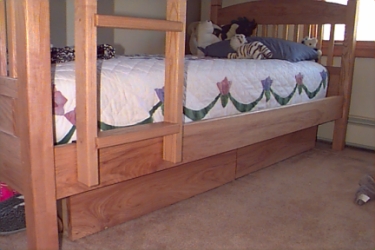 Recently,
I added two large drawers to the bottom of the bunk beds to
provide much needed storage space.
These two picture show the drawers open and fully closed.
Wheels can be seen in the second picture. Recently,
I added two large drawers to the bottom of the bunk beds to
provide much needed storage space.
These two picture show the drawers open and fully closed.
Wheels can be seen in the second picture.
The two drawers have 1 inch thick ash
fronts with poplar sides and back. The drawer bottom is 1/4
inch plywood. The drawer sides connect to the front with sliding
dovetails with the front overlapping the sides by about an
inch on each side. On each drawer side are three large wooden
wheels (6 per drawer). The actual wheel diameter is chosen
to match the depth of the carpeting. The drawers are sized
so that when closed, they are recessed a few inches from the
sides of the bed (avoids stubbing toes) as well as from the
ends (head/footboards). Using two drawers means each will
be rather large, increasing the possibility of sagging. Using
three drawers is a possible alternative. I used two drawers
but did not cover the entire 76 inch length of the bed rails.
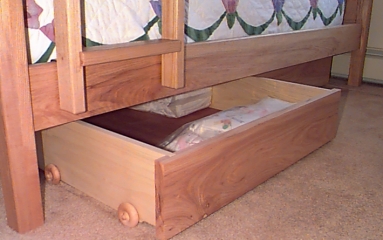 The drawers
are not suspended in any way, rather they roll within guides
hung from the bed's side rails. The guides (two per drawer)
are attached to the rails the same way the slats are mounted
except that they extend down below the bed. The sides of the
drawers bump against these guides to follow a straight course.
For extra protection and smoothness, the drawer sides and
guides are waxed. The guides also have built-in stops that
define how far the drawer can be pushed in. This arrangement
of guides and drawers allows maximum flexibility - the drawers
may be easily relocated should the beds be unstacked, they
do not require drawer hardware nor need to be suspended from
the bed rails and face alignment issues.
The drawers
are not suspended in any way, rather they roll within guides
hung from the bed's side rails. The guides (two per drawer)
are attached to the rails the same way the slats are mounted
except that they extend down below the bed. The sides of the
drawers bump against these guides to follow a straight course.
For extra protection and smoothness, the drawer sides and
guides are waxed. The guides also have built-in stops that
define how far the drawer can be pushed in. This arrangement
of guides and drawers allows maximum flexibility - the drawers
may be easily relocated should the beds be unstacked, they
do not require drawer hardware nor need to be suspended from
the bed rails and face alignment issues.
|


